
Solutions · City operations
Supporting the situation room’s flood judgment with field data
Summary
Sees rainfall and risk changes that differ by neighborhood on one screen, and connects staff alerts with response status. You can base your judgment on rainfall observed close to the field, not a district-wide average.
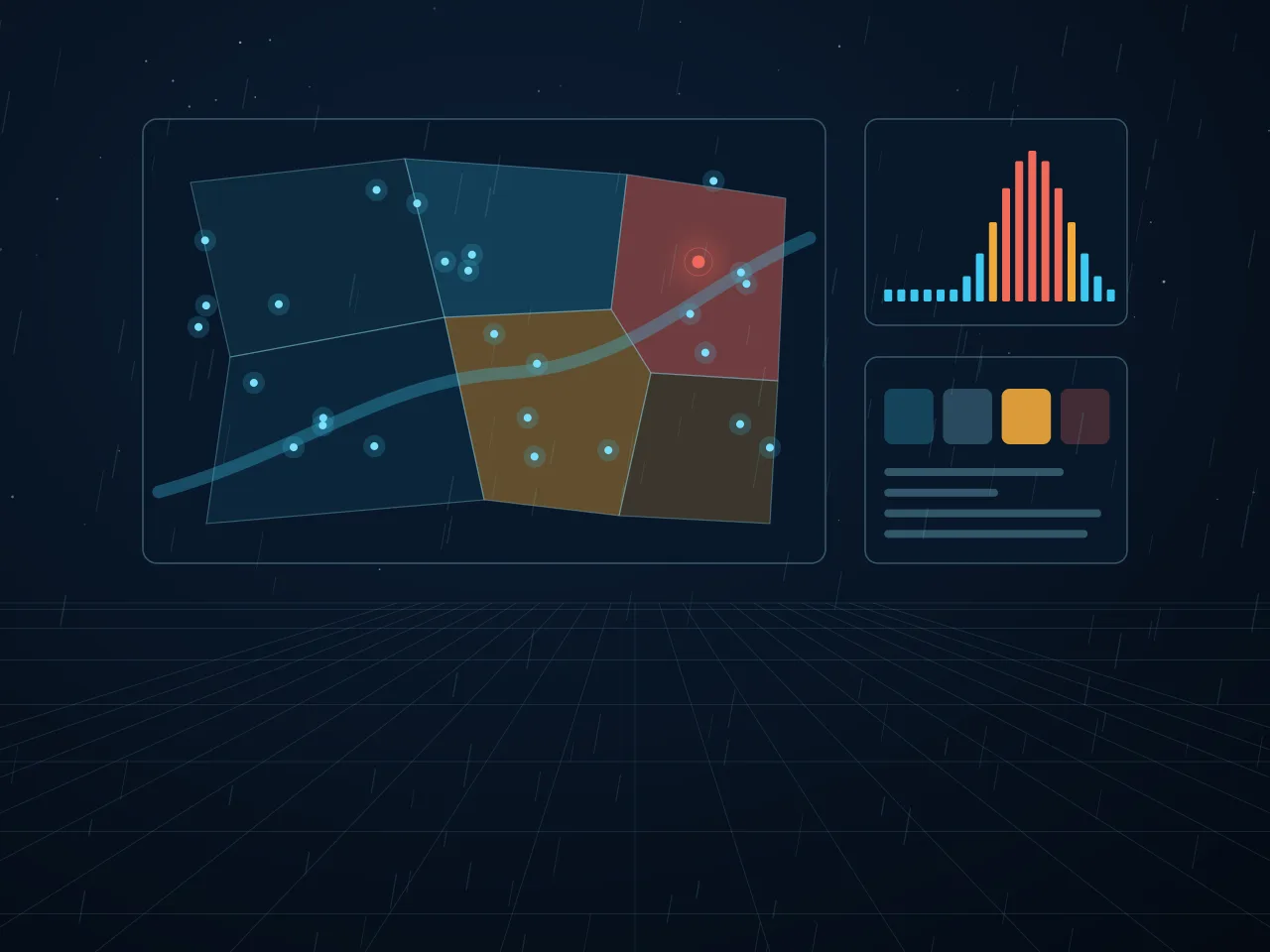
Concept illustration Concept illustration of a monitoring view with risk levels by zone and observation points
The problem
A local downpour’s intensity can vary widely even within the same district. In zones with large gaps between stations, it is easy to notice the risk late.
Even after an advisory or warning is issued, when the chain from the district office to the neighborhood community service center to care staff relies on phone calls and messaging, it is hard to see the field situation at a glance.
Users
- Disaster operations room
Sees rainfall and risk level by zone and decides on issuance and resource deployment.
- District flood-control/safety department
Checks risk changes and response status for its assigned zone.
- Neighborhood community service center
Manages response progress for target households and care staff.
Workflow
- 01
Detection
When one-minute rainfall at an observation point approaches a threshold, the zone is highlighted on the monitoring screen.
- 02
Judgment
The expected flood risk from the analysis engine is reviewed together with public advisories to decide whether to issue.
- 03
Propagation
Pre-configured staged messages go out to staff and target recipients.
- 04
Action confirmation
Evacuation and control progress is tallied at the neighborhood level, reducing reporting calls.
- 05
Post-event review
Observation and action records are kept to refine the criteria for the next heavy-rain response.
Expected operating changes
- Judgment based on field-level rainfall rather than a district average
- Post-issuance communication and reporting organized into an on-screen tally
- Accumulated observation and action records for each storm
Adoption evaluation items
During the pilot phase, we measure the following together with the institution to evaluate the impact of adoption.
- Time from threshold reached to staff confirmation
- Time from issuance to action-completion report
- Data collection rate and quality status by observation point
- Completeness of the action record for each storm
Read the Rain. Protect What Matters.