
Resources · Explainer
What is a high-density rain gauge network?
Summary
In this article, a “high-density rain gauge network” means a network of observation points placed to capture rainfall differences around flood-prone sites in finer detail. Its purpose is to confirm, with field-level values, rain that concentrates in a narrow area, as with a local downpour, and to bring forward the response in places where water collects.
Why it is needed
A local downpour’s intensity can vary widely within a few kilometers. When stations are far apart, rainfall in between has to rely on estimation.
Places where water collects — road underpasses, semi-basement homes, low-lying roads — are sensitive to a short burst of heavy rain. Having an observation point near such places gives risk judgments a clear basis.
Network resolution, compared
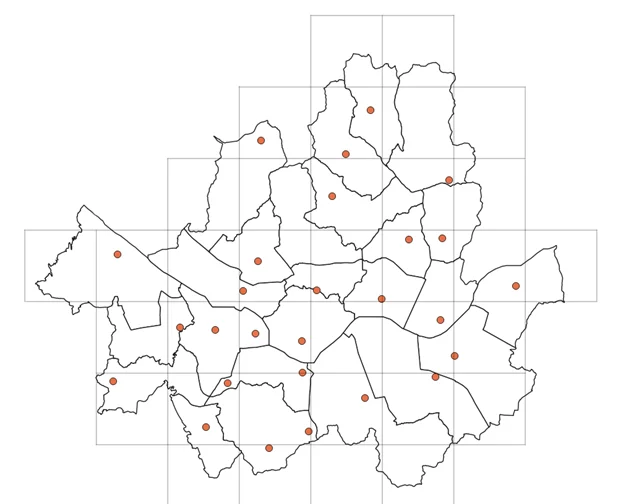
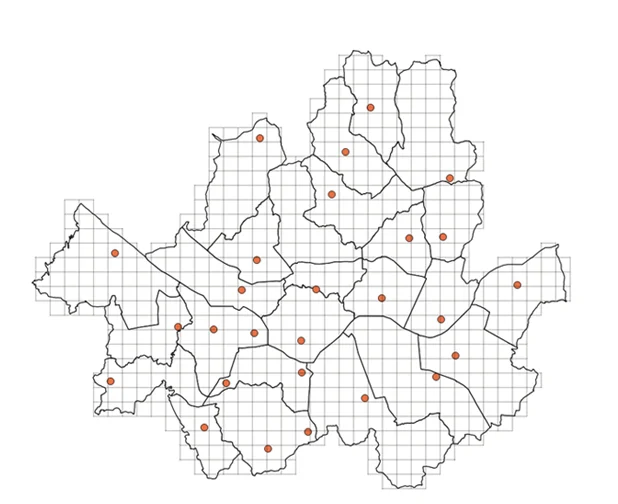
The same map of Seoul, overlaid with the grid of the public weather network and the WOOZZA network. The finer the grid, the less rainfall difference is lost at the scale of an alley or an underpass.
- Public weather network
- ~12 km
- WOOZZA network
- 1 km
What it consists of
A network is not complete with devices alone. It needs, together: ① rain gauges designed to a consistent standard, ② correction and quality control that reduces the effect of the installation environment, ③ an operating system that checks device status remotely, and ④ a monitoring system that connects observations to judgment and alerts.
Relationship to public observation networks
A high-density network does not replace stations and radar run by the Korea Meteorological Administration or local governments; it is complementary observation that fills the gaps between them. Public observation covers a wide-area standard baseline, while high-density observation covers fine field-level differences.
What to consider when operating one
- More observation points means a heavier maintenance burden (cleaning, calibration, communication checks).
- Without correcting for differences in installation environment — rooftop, roadside and so on — comparison between points becomes difficult.
- Filled values and measured values must be recorded distinctly.
Read the Rain. Protect What Matters.