

Solutions · Evacuation
Tracking, together, the evacuation of people who need support
Summary
Pre-connects people who need evacuation support with evacuation support staff, and gathers progress from staff confirmation through dispatch to evacuation completion.
Concept illustration Concept illustration of evacuation routes linking homes to a shelter
The problem
When an advisory or warning is issued, evacuation support staff are often dispatched only after several rounds of phone calls and messaging. In that process it can be hard to grasp, in one step, the location and condition of the person needing support and the availability of support staff.
Confirming that evacuation is complete also has to climb back up through several reporting steps.
Users
- Care officer
Uses rainfall data to identify flood-risk areas, plans evacuation and deploys support staff, and manages the evacuation in real time with residents and staff.
- Evacuation support staff (companion partners)
Works with the care officer to evacuate alongside the resident, reports problems on the way immediately, and delivers needed supplies. Volunteers, NGOs and community members can take part.
- People who need evacuation support
Older adults, people with disabilities, infants and people with chronic illness who find it hard to evacuate alone. They receive risk guidance, share their location if they consent, and request extra help when needed.
Workflow
- 01
Pre-registration
Registers households needing care and evacuation support staff, and pairs them in advance.
Care officer
- 02
Risk detection
Once rainfall at observation points near a target household reaches a threshold, the risk level rises. The detection radius is set by each institution and region (e.g., within 500 m).
Platform
- 03
Alert & dispatch
Staff are notified, and after confirmation, a dispatch request and information about the person needing support are sent to evacuation support staff.
Care officer · evacuation support staff
- 04
Evacuation in progress
Evacuation support staff meet the person needing support, move to a designated location, and log status in the app. If a problem arises during transport, connecting to 119 emergency services is prompted.
Evacuation support staff
- 05
Completion tally
Evacuation completion is tallied at the neighborhood level for reporting to higher-level institutions.
Platform · institution
Field dispatch structure
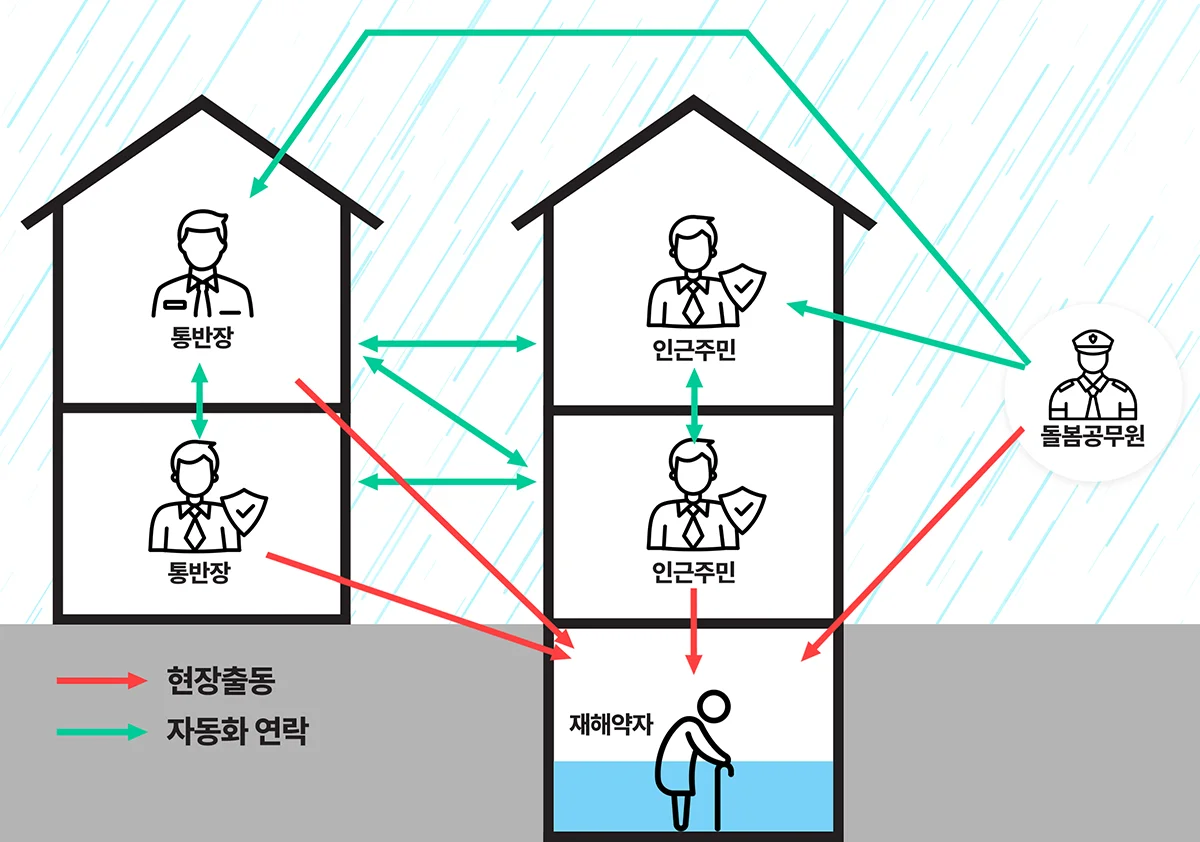
Residents living where water rises first, such as semi-basement homes, are paired in advance with nearby support staff. When risk is detected, the care officer and support staff are contacted automatically and staff head straight to the site.
Fewer rounds of phone calls and messaging mean a single flow from dispatch request to evacuation-complete report.
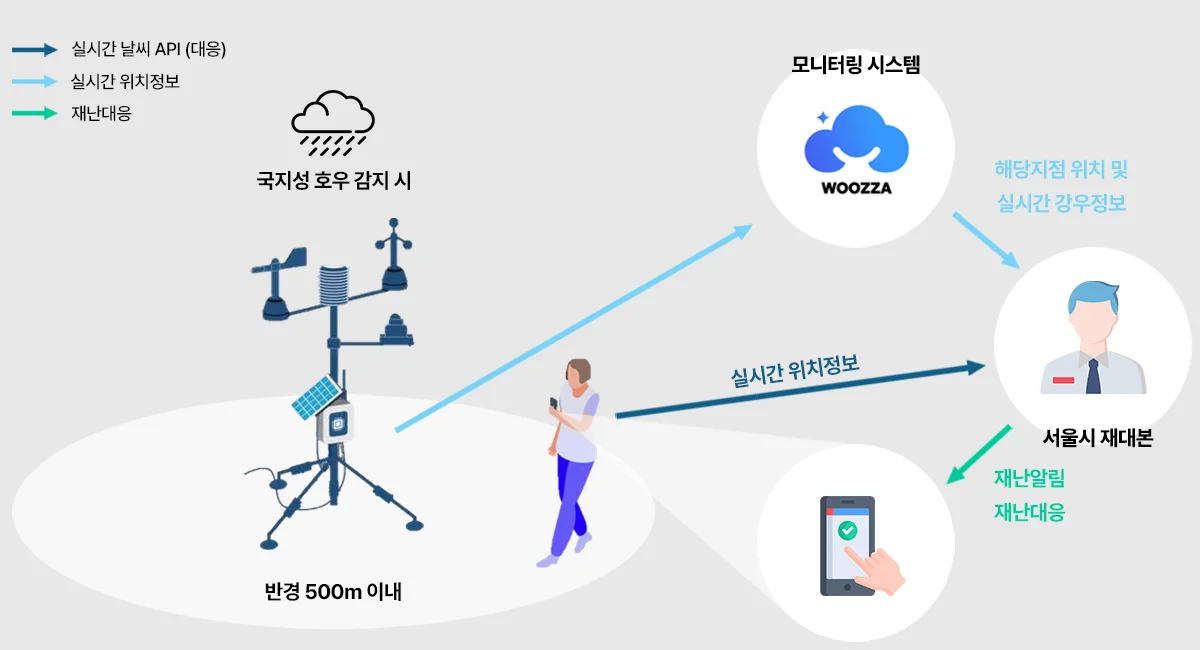
Radius-based risk detection
When a local downpour is detected at observation points within a set radius of a target household, the residents and staff in that radius, the monitoring screen and the disaster response headquarters are alerted together.
The detection radius and thresholds are set to each region and institution’s procedures.
Companion partner dispatch process
A flow based on pilot operations in Seoul. Steps and thresholds are adjusted to each institution.
- 01
Register people
Register residents’ addresses and companion partners, and preset guidance messages by area and role.
- 02
Monitor observations
Watch rain gauge and road water-level data in real time to check whether the institution’s thresholds are reached.
- 03
Convene the response headquarters
As thresholds approach, notify people in the area and convene the disaster response headquarters.
- 04
Issue a flood advisory
After review by the headquarters, an advisory is issued and alerts go out to the area.
- 05
Dispatch companion partners
Companion partners go to their assigned residents, help them evacuate and report completion in the app.
Expected benefits (qualitative)
- Pairing between people who need support and evacuation support staff fixed in advance
- Dispatch requests and completion reports managed on one screen
- Evacuation progress checked at the neighborhood level
Assumptions and cautions
- Handling the personal and location data of people who need support must follow the institution’s legal basis and consent process.
- Administrative procedures such as dispatch-expense settlement are configured to each institution’s own rules.
- Alerts do not substitute for an official emergency text alert.
Read the Rain. Protect What Matters.